Dementia Researcher Visits Cedarbrae C.I. Virtually with VROC #TDSB #STEM #URBANED #SCIED
VROC (Virtual Researcher On Call) featured my class on their blog
See here: http://www.vroc.ca/pir/en/good-news-vroc-story/#more-4234
Thank you so much for the session today with Cedarbrae C.I., Toronto (TDSB). You shared so much of your work and experience with the students. They were amazed at how life can change with dementia. They were very shocked at the stigma and how the lives and families are affected by this diseases. The students really understood when you said the patients “lose what defines them as a human being.” They liked hearing about the different non-pharmacological therapies and strategies that are being used. They felt it is important to improve the care of the patients by training the practitioners like you do in your work. Many of the students are close to their grandparents and would expect proper care for them. We talked after about the vulnerability of the patients and the importance of treating them with dignity.
We really enjoyed watching the Alive Inside documentary you recommended and many of the students felt a strong connection with their own family members. The session opened their eyes to many career options in science and healthcare. They also made the connection with another researcher we chatted with earlier, about grant money and how important it is for research. We discussed the structure of different universities and how researchers can teach, research and apply for grants all part of the job.
Thank you very much for taking time our of your day for us! It was a very valuable and eye opening experience for our grade 10 science class and a perfect way to end our biology unit.
Thank you
Brandon Zoras and Cedarbrae C.I. Grade 10 Science Class
See Alive Inside Documentary Below
Global Collaboration – United Beyond our Diversity Through the Global Teenager Project #ECOO12
MORE INFO CLICK HERE –> http://lanyrd.com/2012/ecoo12/swbmw/
A session at ECOO Conference 2012
This presentation will highlight the use of digital learning circles and global collaboration on major world issues. Using a Wiki as a space to collaborate, students from around the world work in learning circles to, pose questions, investigate and publish answers at a global scale. The Global Teenager Project allows for highly engaging lessons that will link to the curriculum as well as the students own community. This session will provide examples of thematic learning circles grade 6- 12 and particularly highlight the journey a class of Senior students have taken. Participants will learn how to connect and start the program in their own class or school. The wiki will be shared, the research process and clips from web conferences made between a Toronto based school and a global partner from Kenya.
About the speakers

Science Teacher, TDSB,

Anita Townsend
Global Educator, Education Consultant,
Former Principal of Program SCDSB
Educational Computing Organization of Ontario
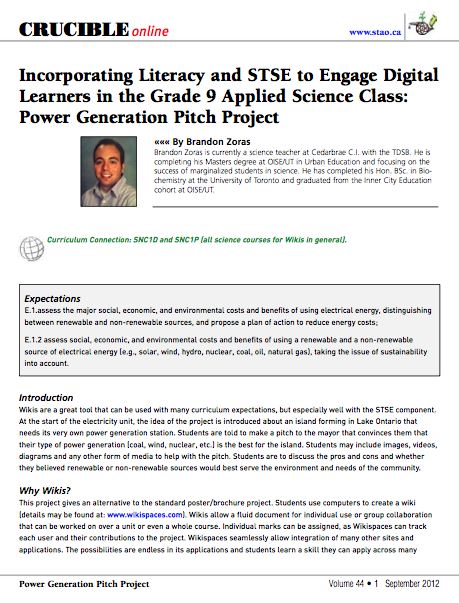
My Lesson Published! Incorporating Literacy and STSE to Engage Digital Learners in the Grade 9 Applied Science Class: Power Generation Pitch Project
I ran a demo classroom on engaging applied level students with technology and STSE education last spring and was encouraged to write to STAO. I sent in my submission and now the final lesson is available here to download:
Download Lesson HERE –> ZORAS_power_generation
Hope it is useful in your classes and please post any feedback or comments !
Cancellation of Extra Curriculars Hurt Inner City Kids The Most #Bill115 #OSSTF
I am stuck between a rock and a hard place today in my career. I am fourth year teacher, and I love coaching and clubs. Today staff made the individual decision to not coach and many clubs followed suit. I am a strong believer in OSSTF and I am personally hit hard with Bill 115.
These kids often do not have the financial freedom to join outside of school clubs or teams. I open the weight room and started this week. Many kids told me this was the first work out since last time I opened the gym because the couldn’t afford it. When I taught at my last school the kids on the football team got to play because equipment was donated. There was slim to no chance they could go play in an outside league. Those students who come from multi-parent homes and middle to upper class can afford these activities and sign them up. I am not saying they don’t deserve the clubs but at least they have alternatives.
It hurts the community as we have clubs like the Eco Club that get involved and green the community. Where should I stand when my rights as an educator are stripped?
I teach amazing lessons, I coach, I volunteer, I plan until all hours of the night and our basic democratic rights are taken from me. I did my masters over the last 3 years, which cost me $13,000 in just tuition alone. I took another two AQ courses this fall for $1,500, this grid freeze hits me hard. The raise I would get for a total of 8 years of post secondary schooling would take 5 years to pay back the $14,500. This is why teachers are mad.
I don’t want people to feel sorry, I feel worse for these kids. The government should see what good teachers actually do for the schools and community. Teaching is not a job for me, it’s a passion, I don’t punch a card out at the end of the day, work always comes home with me, marking, planning, prepping and emotions. I will leave it at that, as I don’t want to get into further politics and into banter over it. It is Dalton McGuinty who claimed to support us, we volunteered with the liberals at the last election and now this Bill 115 isn’t putting students first !
Science for Social Justice
Science is embedded into society and society into science. Often it is taught as a separate facts or terms with a missing humanistic link. The Ontario curriculum has done a good job putting STSE first in the curricular expectations but if it is implemented in the classroom is a different story. Through my masters study, many of those students lacked the connection between their lives and science.
Coming at science from a social justice perspective with a critical lens goes way beyond facts and terms. Who is using science to their benefit and who ends up paying the price?
Angela Calabrese Barton has inspired me with her book on social justice and science as well as her research. Working on the Africentric program science course profile, I wanted to ensure it included social justice at the core. It allows us to critically analyze society, race, class and many other aspects that are deeply rooted within science.
Here are several resources that can be used in class to demonstrate social justice within science and spark change.
Greening the Ghetto – Majora Carter – TED Talk
http://www.ted.com/talks/majora_carter_s_tale_of_urban_renewal.html
“As a black person in America, I am twice as likely as a white person to live in an area where air pollution poses the greatest risk to my health. I am five times more likely to live within walking distance of a power plant or chemical facility — which I do.” – Majora Carter
Blood in the Mobile – Documentary
“The main part of minerals used to produce cell phones are coming from the mines in the Eastern DR Congo. The Western World is buying these so-called conflict minerals and thereby finances a civil war that, according to human rights organisations, has been the bloodiest conflict since World War II: During the last 15 years the conflict has cost the lives of more than 5 million people and 300.000 women have been raped. The war will continue as long as armed groups can finance their warfare by selling minerals.” – Blood in the Mobile

94 Elements – Copper Acid and Dust – Documentary
http://www.94elements.com/elements/29/
“So I have mixed feelings about this film, knowing that we had to stop filming right when I felt we were just beginning to make something quite special with Sanjay. The workers in each compound usually all come from the same village, most having migrated from rural Bihar State, India’s poorest province. I was struck by the similarities between their new work with the copper and the agricultural labour they had left behind. The unhappy irony being that their work now poisons the same land which used to grow their crops.” – Mike Paterson

Teaching in Taiwan
I have been teaching for 4 days in Taiwan and it has been a great experience so far. Getting used to the heat and humidity is a whole other issue.
The schools here are compound like, with fence all around the entire school. Most schools are like that here. The gate at the front has a security guard who welcomes everyone. The principal also stands at the gate saying good morning to parents, staff and students. At first when I visited the night before it seemed more like a prison feel but in the morning the sense of community and caring was very strong. The students eat lunch together and take turns taking care of the recycling of organic and paper waste, nearly everything is recycled here, the garbage is so small compared to the recycling. During the afternoon recess time the students have chores to do. From sweeping, mopping, taking out the garbage, cleaning the board and washrooms, the students do all the cleaning. The amount of respect they have for the building is phenomenal, I haven’t seen anyone litter or make a mess.
The students are attending a summer program but are coming from a variety of socioeconomic classes. In Tao Yuan where the school is, about an hour from Taipei, they are simpler here. It is still busy but the food is cheap and you don’t see the same high fashion as Taipei. Everyone is welcoming, helpful and loves to practice English with you when they can. Many of the adults tell me they learned from HBO, I thought that was funny.
This experience has taught me a lot about education itself. Having a sense of community and giving responsibility to the students gives them a sense of ownership. If we applied these concepts in our schools, bringing in the community and providing the opportunity to allow student ownership, I think students would have a greater respect for the school and their learning.
Graduation of Pathways to Education Regent Park Students
What an amazing way to celebrate the accomplishments of the youth from schools around the Regent Park area. I attended the graduation as a guest to see my former students graduate out of the Pathways to Education program. Although they are leaving high school they were told over and over throughout the night Pathways will always be there for them.
My students that were part of Pathways always had good things to say about the program. From mentoring, tutoring, in and out of school they had access to quality assistance. The students being from a marginalized area, face many obstacles in their daily lives. By having support, financial assistance, bus tickets, and tutoring, it took the pressure of the student.
I am so very proud off all my former students and seeing the looks on their faces was incredible. Shaking their hands and hearing they will be attending university, colleges and working right after high school was very exciting. The families and whole community came together as a whole to celebrate the hard work and accomplishments of these students. Regent Park has a great community and is only getting better with organizations such as Pathways.

Toronto Urban Education Blog
Tomorrow is the last day of my Masters of Education program and what better way to celebrate is hosting a research poster symposium. For all those who can not make it or not from Toronto here is the link to our groups blog that has research summaries and our posters in PDF that you can download. Search by author at the top or scroll through each. We are updating this week to include all of us from the group.
Inner City Science Education: Engaging Urban Boys Back Into Science – My Thesis In 4 Pages
Well, 3 year journey is coming to an end of my masters program at OISE in Urban Education. The poster symposium is in a previous post but June 13th, 6 PM at OISE Library we will be showcasing our work. Attached is the PDF of the summary or you can read the text version below. Comments and Questions would be greatly appreciated!
4 Page Summary Brandon Zoras Research
Poster: Brandon Zoras Poster
Brandon John Zoras, OCT, Hon B.Sc. B.Ed. M.Ed (June 2012)
From teaching in many inner city schools in Toronto, I noticed that many boys are not continuing on past the mandatory grade 10 science course. This presents problems with the current model of teaching science, as we are not engaging an entire group through curriculum, lessons, strategies and content. Science education provides a key to a larger variety of jobs, higher wages, understanding medical diagnoses, and a greater knowledge about the world around them.
Completing my masters at Ontario Institute for Studies in Education (OISE) at University of Toronto, my program took a critical stance on examining inner city issues in education. The Centre for Urban Schooling (CUS) at OISE, works with many organizations and school boards to challenge power relations based on class, race, gender, language, sexuality, religion, ethnicity and ability as they are manifested in all aspects of education, both formally and informally. Male students in urban schools needed a voice to show educators why they are stopping taking science. Interviews and assessment of achievement data were conducted at two inner schools with males who stopped taking science after grade 10.
Student Voice
Why were the students stopping taking science? What factors led them to that decision? Where were they succeeding? What activities worked well for them? The answers came through the voice of the students directly. Many important themes emerged with focus on the following key themes:
Trust
Trust was used as a descriptor of school itself and the staff within. Students referred to teachers and staff they could trust as limited in the school but being central for their learning. Those who coached or mentored the students in extracurricular activities and then taught the students often were met with less resistance and overall students achieved better grades in those classes.
“I usually do things myself, do it all, my school work myself but if I need help I can go to parents or teachers I trust” – Evan
Those teachers they trusted, often worked hard to bring in extra curricular activities and got to know the students on a personal level. To empower these males by showing them their own potential and have them advocate in the proper avenues is important. Often the students felt they were not trusted to do labs or group activities. This resulted in quiet seat work consisting of copying notes, worksheets and filling in the blanks.
“TRUST! Trust them, do more experiments, make classes more interesting, instead of a lot of talking and reading, more interesting…” – Robbie
Success and Support
Giving the student power and choice will lead to a greater effort and better results. Looking at the achievement of the students in this study, the average mark for grade 9 science in both schools was 65 % while the average mark for grade 10 was 55%. Students showed on average a 10% drop in their final science mark between grade 9 and grade 10. According to the Ontario Curriculum’s Science Achievement Chart, a mark between 50-59% means limited knowledge and effectiveness has been achieved in the science course. This is not preparing students to be scientifically literate. For the students in this study, this was their last science course and by sending them into further courses and career options with only “limited effectiveness” in terms of science knowledge and communication is not acceptable.
“More experiments, way less hand outs, and actually learn useful things, more diagrams so we can actual see, instead of just reading from the paper” – Kevin
Many of students interviewed spoke of the support they got outside of school. They talked about community organizations that helped them with schoolwork and other opportunities. The students from one of the schools spoke about Pathways to Education (pathwaystoeducation.com), a community based program to help low income youth graduate and break free from the cycle of poverty. Five of the interviewed students, who live in Regent Park, said they take advantage of the programs offered by Pathways to Education. Community support programs, non-profits and libraries need to form a community hub alongside schools.
“I normally have a few teachers who can help me, most of advice but when its school work I go to pathways, I am part of Pathways to Education and they offer tutoring” – Salman
Relationships
Showing care for the students in a genuine manor also added to making a safe learning space where students felt comfortable enough to learn. An open communication between teacher and student is critical for learning. With the rich diversity of students within inner city schools, much of the students’ cultural capital is left at the door and the dominant cultural opinions and knowledge are learned.
“the difference between successful teachers and teachers who are not liked, successful teachers know how to interact with different kids, the non successful teachers are always telling you to do what they want to do and how they do it. Successful teachers diversify” – Kevin
The important factors to them are having this caring and trusting adult that shows respect to the students and brings in exciting material. Interestingly enough, pay scale and ratings do not have an impact on those interviewed, on how well the students do or how much they learn nor do the credentials and years the teacher has been working.
Views and Values of Science
A subject that often emerges when talking about students being disengaged in science is that students may not see examples of their own people, race, culture or background infused within the science courses or within the media. Others are unaware or not wanting to know the science that surrounds their daily activities and occurrences.
“…science is everything, it’s the air around us, you need science to breath” – Trevor
Many of these students lack the rich experiences of incorporating culture and race in science, so therefore are unable to see the benefits. Bringing in the culture of the students and allowing them to expand on their cultural capital as well as looking at achievements of non-western scientists as well, would allow for a richer learning experience. When asked what a scientist looks like, all but 2 students mentioned race as being white, while the majority of the students interviewed were students of colour.
“first…first picture, they would…I don’t know…honestly…probably like a white guy in a lab coat or something hahah, to be real still. But like I know there is black scientists…you know and all that stuff. But like in a book, that’s a white guy.” – Sean
Barriers
Many inner city students face barriers and obstacles even before they get to school. Waking up, finding a proper breakfast, transportation and taking care of family members are just some responsibilities many of these young males face even before arriving at school. Science classes are often linked to previous and future lessons, labs, topics and content. Students missing class can lead to an overwhelming feeling of not being able to catch up if they fall behind. Teachers, administrators and support staff need to work on catching these students up and keeping them attending. Dave supports his family by working part time, making his siblings lunches and making sure they get to school and often getting to class is an issue for him.
“just showing up…it’s first period…” – Dave
How we can support inner city males?
Lessons, curriculum, policy and pedagogy should always have students in mind first. The teacher has the power to advocate, empower and create a safe learning environment for all students. Urban science educators should first off, set up a comfortable learning environment for all students. This means acknowledging all students by recognizing differences and validating their lived experiences. Making the student become an active participant gives the student responsibility to the learning process and content. Creating a learning community where students can bring in their cultural capital puts the accountability on the learners as well.
For science content, it is important to recognize their previous knowledge and allow students to expand upon that. Students have a mix of science backgrounds from culture, personal views and school science. From the time they have started walking and exploring the world around them, students have started building observations and theories about science. Worksheets, textbook work and cookie cutter labs are not engaging. Implementing inquiry based labs, group learning and incorporating technology works well to keep students engaged and have meaningful learning experiences. Having students work on community-based projects, for example greening a local area, studying pond water samples, viewing biodiversity in the community and then making a change is important. Global collaboration is possible and tested this semester in my own class through learning circles, wikis and video conferencing with a school in Kenya on environmental sustainability (globalteenager.org). Having scientists and researchers of all walks of life come into the class virtually to talk about new research was another great experience (vroc.ca). These may seem like great leaps and high expectations but many community groups are willing to partner to make this possible. From the students’ voices and lived experiences educators can make changes that increases engagement and production of successful urban male science students.
All names are pseudonyms. all protocols for this study have been approved by OISE/UT and the school board.
Contact: Brandon John Zoras
brandon.zoras (AT) mail (dot) utoronto (dot) ca
Global Teenager Project Meeting: Using Wikis for Global Collaboration
After being part of the Global Teenager Project this semester I was able to meet with others in the project face to face and also the director of Mr Bob Hofman who flew all the way from the Netherlands (http://www.globalteenager.org/)
With the amount of technology we use and possibility of having virtual meetings it was nice to have a face to face meeting with the group. Garfield Gini-Newman was also present discussing the importance of critical thinking and best practices in embedding them into the classroom. The other teachers involved in the project discussed how they used the project to connect.
I really enjoyed the project as students worked on Environmental Sustainability as the main topic. Students collaborated on their own wiki and we posted collectively on the global teenager project wiki (https://gtpenvironmentalsustainabilityfeb2012.pbworks.com/w/page/50830328/FrontPage). We talked to schools from around the world by submitting critical questions and answering. We learned from a global perspective how out activity affects other places in the world. A big development was that we connected counties thousands of kilometers away to work on a common goal. We used Skype to talk to talk to one of the schools in Kenya where we further discussed environmental sustainability.
Details of the meeting below.
http://www.ict-edu.nl/sjablonen/ictene/index.asp?subsite=144&aqua_main=144&aqua_sub=33&pagina=1591
Present at the workshop
Helen Raso – Bishop Strachan School
Stephanie Ratti – Redstone
Sally Loats
Brandon Zoras – Cedarbrae C.I., TDSB
Amy Scarpone and Sabrina Asti – Bruce Trail
Grant Davidson – ICT Consultant Haltton School Board
Garfield Gini-Newman – OISE
Anita Townsend – GTP Country Coordinator Canada
Bob Hofman – Executive Director GTP

 brandonzoras.ca